Steve McCurry is a photographer I've known about and lauded ever since I studied him in 7th grade. His ability to astound and shock and provoke through the medium of photography is, in my mind, unparalleled with any modern photographers. His portfolio is formidable. It is with photos such as the one presented above that he upholds my high expectations for his work.
Sunday, April 28, 2013
The Power of the Image
Steve McCurry is a photographer I've known about and lauded ever since I studied him in 7th grade. His ability to astound and shock and provoke through the medium of photography is, in my mind, unparalleled with any modern photographers. His portfolio is formidable. It is with photos such as the one presented above that he upholds my high expectations for his work.
Sunday, April 21, 2013
Through My Eyes: The American Gun Debate
The concept of a gun was extremely distant from my understanding. While you might think a girl living in a small Texan town would have been absolutely comfortable seeing a rifle or shotgun, that was far from the case. Guns were fictional things used in the Wild Wild West, extreme cases of war, or police for protection against bad guys who were trying to hurt people. I grew up thinking that guns were illegal! Never would I have thought that anyone could go get a permit, then be allowed by the government to purchase a gun. I mean, if someone was in a bad mood one day, then they could pull out their gun, aim it at a bystander, and ultimately end a life. The idea horrified me! I couldn't even fathom the thought that an average Joe, someone I might see walking down the street, could actually have a gun in their coat.
"A well regulated Militia, being necessary to the security of a free State, the right of the people to keep and bear Arms, shall not be infringed."
The Second Amendment states that all have the right to bear arms (aka anyone can have a gun) and that those rights shouldn't be infringed on by the government. The founding fathers saw guns as means for people to have protect themselves - particularly against a corrupt and oppressive government (as they facing the British threat of tyranny at the time). I can understand the need for the longing to protect guns back then, particularly as American independence was so ripe and in need of protection; but, times have changed.
I'm not singling out handguns, for I can understand their merit for those who feel threatened or want to be protected (particularly women). What I am talking about is the need to have assault weapons. These weapons, in the hands of criminals, pose an incomprehensible threat to countess innocent people. Semi-automatic weapons are capable of firing far more rounds per minute, enabling criminals to kill more innocent civilians in the event of a massacre. This I don't understand. If people see the need for guns for hunting, or protecting themselves, why would they ever need a weapon that can cause such mass death, pain and destruction in a shocking scale. They are not meant for self defense, they are military weaponry. Their sole purpose is to hunt others down with the intent to kill in mass quantities. Anyone who claims that they require possession of such weapons are senseless.
On January 8, 2011 in Tuscon, Arizona a 22 year old fired 33 shots, killing 6 (including 9 year old Christina Taylor Green) and wounding 13 (including the critical injuring of Congresswoman Gabriel Giffords).
On July 20, 2012 in Aurora, Colorado a 24 year old fired over 70 shots (100 round ammo magazine capacity), killing 12 and wounding 58 people in a movie theater during a showing of "The Dark Knight Rises".
On December 14, 2012 in Newtown, Conneticut at Sandy Hook Elementary a 20 year old fired over 150 shots and ended the life of 27 people (20 of whom were children aged 6 and 7).
Just recently in the Senate, measures to develop a renewed assault weapons ban and ensure background checks for all forms of gun purchases were quashed. That fact makes me sick to my very core. Supporting gun control and regulation isn't un-American. Wanting to do everything possible to save the lives of the innocent isn't contradicting the national ethos. America was always meant to be a "city upon a hill" that other nations would strive to emulate. A nation in which people are preventing reforms which could potentially save lives of citizens is cowardly, irrational, and far from warranting emulation.
The role of government is to regulate and protect it's people from not only the threat of other nations, but from one another. Congress is losing sight of that fact. People who long to remain in power are allowing the longing to retain their previous constituencies for the sake of reelection cloud their basic human instincts and judgement. It is time that the need for basic gun control and regulation become a national recognition and understanding. Rather than getting things done, regional and political differences have led to power-plays. Every moment that such reforms are stalled, we get closer to another Tuscon, Aurora, or even Newtown. Enough is enough.
Thursday, April 18, 2013
Persuasive Essay
The world, in all honesty, is a sick and twisted place. It is filled with sick and twisted people, thinking sick and twisted things. Thirty years ago, that was fine. People simply got on with their lives, keeping their sick and twisted nature to themselves. For a misogynist, racist, or bigot to actually have their thoughts promulgate outside their tight knit communities, they would have to get up off their couch and do something about it. That's not to say that many of those people weren't successful in conveying their sick and twisted message, but it took a heck of a lot more time and effort than in the modern era.
The problem today, however, is this tiny little screen with tiny little buttons which allow such people to share their horrid thoughts with the stroke of their fingertips. The most wretched, downright wrong words can be shared through an unfathomable number of mediums, where there is often no filter. By its inherent nature, the internet is a place lacking restraint. Faceless people behind screens have power. While we have undoubtedly seen the good that such power has shown, as was the case with women in Saudi Arabia tweeting of their nation's injustices, we have also come to recognize the bad. Both the strengths and ills of society are showcased on the world stage. Through Youtube, Facebook, Tumblr and Twitter the collective world is represented in an unbridled way. We see hate speech, videos ridiculing religion, platforms to objectify and degrade genders and races. The internet can be a sick place.
It is because of the internet's platform for 'hate' speech that countries have taken internet censorship into their own hands. I'm not talking about nations like China who ban sites so as to thwart the sharing of anti-government / human rights sentiments. I'm not talking about the dictatorial regime of Syria who has essentially prohibited their nation from any form of internet connectivity to the outside world. I'm referencing nations like Germany, one that is very much pro-civil liberties and human rights, who in October blocked content of a Neo-Nazi group through Twitter. They saw that their nation, one whose history is plagued by the horrific ideologies of Adolf Hitler, was being reintroduced to ideas meant to incite anger and outrage within society; therefore, they quelled those who spoke out against their beliefs concerning basic human decency. They restricted the online realm.
While I understand and appreciate the actions of nations like Germany, I must nevertheless disagree. What good will hindering expression do? Doesn't showing disdain towards the 'bad' give them a sense of legitimacy?
I say let the hate speech flow! Let these people sing of their sexism and racism. Let ignorance reign free, for it is only then that people will recognize that such thought still exists. It is only when people are faced with such ridiculous injustices that they recognize and truly form their own opinions and perspectives about the world. It strengthens the resolves of those who are 'good'. The African American lobbying for rights would never have occurred were it not for Roger B. Taney and Orval Faubus disgusting opinions, sparking the flame of rebellion in John Brown, Frederick Douglas, WEB Dubois and Martin Luther King Jr. People must challenge our opinions in order for us to recognize and solidify our own beliefs.
Of course, one day I want to go on social media without being drowned by appalled statuses calling for the end to ignorance and crying for a shred of human decency. It would be amazing if we all held hands and sang about unity and rainbows and butterflies. However, for the time being, freedom of expression is an advantage. Human expression is healthy. We can only escape the loop of injustice and ignorance if we open the world up to an international dialogue, and such debate and passion can't be stirred up if we don't allow the "sick and twisted" people the opportunity to be challenged.
Internet response to the Boston Bombing
*warning, some graphic language
Wednesday, April 10, 2013
My Reflection on “On Compassion” by Barbara Lazear Ascher
My parents were always worried about me as a child, and still are today, because I often allow feelings of empathy or compassion get the better of me. I have always been a softie. I would loathe it when my parents would play the news when I was a kid back in Texas. This was around the post-911 times, when the world seemed to be in chaos. I'd hear about the people dying in the tsunami that hit in 2004 and cry. I'd see biography's of the soldiers who died in Iraq and cry. It got so bad that my parents would never allow me to be in the room when the news was playing. I'd hear the death toll for Hurricane Katrina, and I would bawl. The thought of other people suffering in such horrific ways would keep me awake at night. Though the emotions quelled a bit as I got older, I still always felt the need to do something.
When I was roughly ten, I began to notice that as we drove through the bridges in Houston that their would be people sitting with shopping carts, some even fashioning homes out of old trash bags to protect themselves from the sun. Eventually, my parents became a bit worried when we would give them money (unsure of where the money would go to), so we would get goodie bags to pass around. They would be filled with food, a little bit of money, a bus pass, etc. From there, we began tutoring youth in their poorer community in an attempt to break the chain of poverty. That has always, even today, been a system and philosophy which my family and I have followed. You can't simply turn the other cheek. You must accept and act upon your compassion, not simply ignore its presence.
I feel as though the greatest threat to human compassion and care today is indifference. Some people seem to think "Oh, they're not going to use money for food anyways", "Oh, they should just get a job", or "If I give to them, then I have to give to everyone" rather than seeking actual ways to help. People make excuses. I often observe how many simply ignore beggars on the street, intentionally zooming past them and avoiding any eye contact. However, this doesn't mean that they lack compassion, it simply means that they prioritizing themselves.
Sunday, April 7, 2013
My reflection on "Failing to Learn Japanese in Only Five minutes"
One time, when I was roughly eight years young, I snuck deep into my mother’s closet and became overwhelmed with giggles at the sight her old drivers license (Debra Winger hair, red lips, and all). Though she graciously laughed along and showed me an old scrapbook, she claimed that one day, in the not so distant future, my children/nieces/nephews would be doing the exact same thing with me. She dared to suggest that I would be the ancient one sharing my photographs, not mocking the age of others. I refused to even acknowledge such a suggestion as being in the realm of possibility. Never would I be “out of date” or “old”. I always held a firm belief that my existence coincided with the absolute and complete development of humankind’s technological capacity. In my mind, the world would stop developing because their was nothing left to develop. I couldn’t have been more wrong. Unbeknownst to me, my mother’s claims would ring true very soon, with the source of such harsh reality to come from none other than my little sister.
Just last week, over the dinner table, my family and I found ourselves reminiscing over our time in America. We remembered going CD shopping fo JoJo records, how we had a cassette player in my dad’s old car, and our VCR, on which my elder sister and I would relentlessly watch Spy Kids and The Sound of Music, constantly having to rewind the tapes after each viewing. We recalled when Youtube just began to grow popular, and how we would still send handwritten cards to our cousins on their birthdays (but had to send them a couple of days in advance so that they would arrive at the perfect time). As we referenced everything nostalgic thing from our past, my little sister was in awe. Half the things we spoke of she didn’t know. She couldn’t imagine a time when our house only had two computers (and we had to unplug the phone to use the internet), a time when the primary use of the letter “i” wasn’t as a prefix for a string of elaborate technological products, or a time when the word “tweet” was only used when reenacting the chirping of a bird during a rousing rendition of "Old MacDonald". Though I am only five years older than my sister, I was the old lady who lived before the technological revolution she was always a part of.
Thursday, March 24, 2011
How Ethnocentricity Inducts Conflict
Thursday, February 24, 2011
Marc Antony's Speech

-->
Tuesday, February 1, 2011
Profile K Evaluation

Today in class Mr. Whiting came in and talked to us about the two hemispheres of our brain: Logic and Gestalt. If someone relies more on the left side of their brain to process information, they are logically centered, and if they rely on the right side of their brain more, they are considered Gestalt. Those who are logical tend to prefer having instruction, work in a neat, sequential matter, and tend to direct their focus towards details. Those which are Gestalt tend to work in a more abstract way, tend to be more curious, and focus on the big picture, without paying so much attention to details.
Through a few forms of testing our brains, I was able to reaffirm that I am a Gestalt person, who is a Profile K Learner (I got the exact same results when doing the same testing in 7th grade).
I learn best when I am given examples of how to do things, as I have trouble following step by step instructions. I prefer not to be told exactly how to apply my thinking, because I feel as though it is restricting me. An example of this would be when writing an essay. I prefer it when I am given an example, and then am able to let my imagination take control of what I am writing. I dislike being given formatting and being told how I am supposed to do things. I use the ‘whole’, and then work with parts of the whole.
Whenever doing work or learning about a new subject, I need to be able to relate to what I am doing in an emotional level, or else I have trouble when attempting to deeply process any sort of information. For Example: When reading Julius Caesar, I was able to understand the protagonist (Brutus), because I understood what it meant to be unsure whether to trust your friends, and how easily even the smartest of people can be manipulated through the use of heavy flattery. Since I was able to relate to the story, I could comprehend the vulnerability of Brutus. Then, I place myself into his mind, and understand the emotions that are provoking his choices.
The strategies that would help me in my learning are to use visuals and constantly change the topic of discussion. Whenever working on a project or learning a new subject, I consistently turn to the use of images, pictures, and diagrams, because they allow me to clearly see the information I am trying to process. I also prefer not having to remain on one subject or topic, because I lose focus. By constantly changing the subject, I come up with new ideas, and am able to exercise my imagination and creativity.
Monday, October 25, 2010
Art Mirroring Society
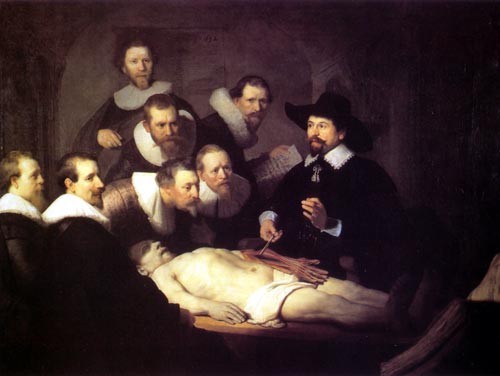
The oil on canvas painting, The Anatomy Lesson of Dr. Nicholas Tulp was drawn by the talented Renaissance artist, Rembrandt, in the year 1632. It illustrates a group of scientist dissecting the body of a burglar who had recently been executed. This painting represents and reflects the culture of the Renaissance, because it shows the progression of scientific knowledge and artistic techniques. Scientific knowledge and discovery is shown through the dissection and study of the dead body. As the people of the Renaissance began to review prior discoveries of the Romans and Greeks, they started to inquire more about the world around them, and questioned the science behind the human body. When the Catholic Church began to loosen the restraints and restrictions of science, scientists were occasionally permitted to expand their research in field of medicine. This led to a better understanding of human anatomy, and instigated more research and development. Rembrandt’s painting not only displays scientific innovation, but it also shows the new methods and techniques of art that were being applied during the Renaissance. The focal point of the painting is the dead body, there is shading and detail on all the men’s’ clothing, and the corpse is anatomically accurate. These new techniques of art enhance the sense of realism and depth in the painting. In the Renaissance, people began to focus on making art look as life-like as possible, and the new styles and techniques led to more interest in patronizing and commissioning artwork. Talented and skilled artist brought attention to specific city-states and initiated rivalry and competition between the different societies. Art eventually became the center of civilization. Through this painting, you can begin to understand the influence the Renaissance’s thriving society had on Europe, and how it was reflected not only through improved artistic methods, but also through the subjects of the paintings.
Tuesday, September 28, 2010
Driving forces of the Renaissance
I believe that the system of guilds was the most crucial driving force of the Renaissance, because it established the civilizations' economy through the development of art and trade, thus stimulating the progression of knowledge and skill during the Renaissance. As the guilds flourished during the 15th century, newfound wealth of the city-states led to grand competitions for the most knowledge, and the rediscovery of lost wisdom. Because of its vital and influencial role in the revival of society, guilds were the foundation of the Renaissance.
image source: http://www.lessons-from-history.com/
Sunday, January 24, 2010
“If you wait, people will forget your camera, and the soul will drift up into view.”

After exploring the many galleries of Steve McCurry, the photo that is always carved into my mind is of a boy running through a hall that is covered with red hand prints. The walls are bright blue, and the prints are a deep, burgundy red. The two colors collide, capturing peoples’ attention. Undoubtedly, the most intriguing aspect of this photo is the aura of mystery. It captures a fleeting moment in the boy’s life and freezes it. The scene is completely up for interpretation. The reader could create many reasons for why the boy was running. Could he be playing a game of tag, did his mother just call him to come over for lunch, or could a man with a gun be just behind the photographer? They could also wonder about the handprints. Were they little decorations for the street, or were they representing the blood of children that were shed in some kind of war? This sense of liberty McCurry set up for the viewer forms a connection, as if they were a part of the scene occurring within the frame. “A good picture makes us curious and makes us want to know more.”
When people first see the photo I think that they mainly focus on the boy running and the red hands. This is because the hands are in the front, and the boy is in the center of the photo, emphasizing the two main features. After staring at the captured moment for a few more seconds, the viewer looks deeper. After my eyes wandered around the page they kept flickering back to the orange wall on the right of the picture. This was put in keenly by McCurry because it subtly shows people the conditions that the boy lives in. The wall is cracking and slowly rotting away. The walls and floor are the background of the photo, and tell their own story of the poverty in the area. The foreground, the boy and hands, shows the intricate attributes and the background, the rotting walls, shows simplicity.
McCurry uses foreground and background, color contrast, size and position, and more in order to have world class photography. He pours peoples’ hearts out through the lens and allows their voices to be heard. Many of his photos show fear through the innocent eyes of children, or the strain on an old woman’s face and McCurry allows their sorrow to seep into peoples’ souls. He shows raw and tender moments in the lives of strangers. “Fishermen cleaning nets, families sharing meals and celebrations, artisans crafting their wares, nomads continually on the move; even the most seemingly mundane activities can be inspirational when you look beneath the surface." McCurry photos display the internal and physical pain of an average person placed in a tormenting, impossible situation. He challenges us to act. It is because of this that McCurry’s photos will endure forever. No matter how much time may pass, the distress on the peoples’ faces will never fade away, and it will stick with you long after you have shifted your eyes away from the photo. It is because of this that McCurry will forever and always be a legend.
Sunday, September 27, 2009
Curiosity in Pandora and Orphan Boy

Curiosity is the underlying theme in the Greek and African myths, Pandora's Box and Orphan Boy, because they both portray how curiosity can unleash negativity and change the entire world. In Pandora's Box, Pandora receives a box from Zeus, and can’t resist opening it. The world is changed because all pain and suffering is released. In Orphan Boy, an old man receives help from a magical boy, but betrays his trust by spying on him. The boy abandons him, causing drought and famine. In both of these myths, curiosity is shown in a negative light, but curiosity has also led to discovery of technology and medicine, saving people’s lives.
(http://images.barnesandnoble.com/images/19090000/19090675.JPG
http://media.photobucket.com/image/pandora/Pandora01/Pandora-1.jpg)
Monday, September 14, 2009
My Name

My name is like my own, individual brand of sticky glue. Initially, the brand name catches the attention of a passerby at a market or store. Only catching a glimpse of a few letters, they are intrigued. They must buy that glue. The customer realizes that it may come in handy someday. They purchase it. Not entirely satisfied by the glue, they chuck it into an old cupboard of pointless objects. The next day, they casually visit the market once again, and they catch a glance of this brand of glue that is perfect for their faltering chair. They try out the glue at home, and it is sturdy and tough. Eventually they run out of that glue, and now have to go and purchase something for the little chip on the coffee table. They remembered that old, forgotten glue, and pull it out of the reject cupboard. Instead of wasting time searching for more glue, they use the old one. Although it wasn’t great, it did hold things together.
If you still haven’t guessed, my name is that innocent, little, reject glue. My sister was the broken chair, who was secured by the best glue, and I was the coffee table, being held together by the discarded one. My parents were searching for a name for my older sister, and they came across mine, but they chucked it aside for the new one they had found for her. Once I was born, they settled for the name that was chucked aside.
I am not declaring that I hate my name, but sometimes it doesn’t quite express me. In Hebrew and Latin it means grace, in Japanese it signifies an apricot, and in Sanskrit it means grain. I am by no means graceful, I am not quite fond of apricots, and I am quite certain I am not a grain.
My name is like a perfectly fitted dress, but unlike anything else, this dress transforms as I do. As I am very leisurely and gradually growing up, this dress alters with me. It has become all the times my mother has shrieked my name for me to tidy my room, and my big sister squealing at me when I “accidently” wore her favourite shirt.
My sister’s name is simple, short, and like nothing you have ever heard. It flows nicely, and any nickname it has, is longer. It is only 3 words, and two of them are vowels. It can be nicknames for other names, but nothing can be a nickname for it. Her name is Lua.
My name may have seemed like the old, unwanted glue, but it is not my identity, I am its identity. It is my yellow Livestrong band that once on, never comes off. It is actually a common name, Anna, but with an interesting twist from the suffix. Many people tend to pronounce it improperly. My name has been like a veil, protecting me from feeling any frustration. I have gone through entire years allowing people to say it wrong, but as long as I know, deep down, my name, and my identity, nothing can thwart me. My name is me, but I am it. Every day, and every night I am Anissa. My name has stuck with me through thick and thin, and it will never abandon me, no matter what.
(http://static.howstuffworks.com/gif/multipurpose-glues-1.jpg)
Common Themes Of Creation Myths

Throughout time, various countries have each developed a distinct representation for the evolution of mankind. Chaos, supreme creators, and separation are the three elements that unite the Egyptian, Maori, and Chinese cultures. In the Egyptian and Maori myths, originally there was a void of nothingness. The Chinese assumed that the universe was initially shaped as a cosmic egg, but within it was nothing. From these voids of nothing came the supreme creators. The Egyptians believed their creator, Atum, materialized from the chaos, and gave birth to the gods, earth, and sky. In the Maori myth, instead of giving birth to the earth and sky, the two first beings were the earth and sky. The Chinese believed that their creator, Phan Ku, came out of the cosmic egg, and fashioned our universe with his chisel. In each creation myth there seemed to be some kind of separation that was crucial for the development of the earth. In the Egyptian creation myth, the earth and sky were separated because of their love for their creator, who wanted to form the earth. The Maoris also believed that the earth and the sky were disjoined, but only because their children pushed them apart for more room. In order to complete the Earth, the Chinese say that Phan Ku needed to die and use his body to finish the landscape. Mankind then lost him, which is the justification for human suffering. From these connections it evidently appears as though in creation myths people used to think alike, even though nowadays we are such individuals. I think that the myths have endured throughout time because they help explain the formation of the world and human nature, answering the questions humans have always been seeking.
Thursday, September 3, 2009
Picture and Quote Explanation

The dark silhouette of the lonesome man is visible on the beach, with footprints in the sand showing where he had originally come from. The sky is enshrouding him like a blanket. There is nothing in front of him, yet he continues on in his way. To me it symbolizes life's journey. We continue on, not certain about what will transpire. Sometimes we are alone, but it can’t hinder us. No obstacle should prevent us from continuing.
Explanation for Quote
This quote specifically seized my attention, because it shows the free will of mankind, and the choices we make. Throughout our lives we make decisions, and continue on in our journey of life. To be an individual, we need to pursue our own paths and not follow everyone else. We must be unbound and limitless. We should be unrestrained like the wind. Nothing should ever thwart us from fulfilling our dreams. Our journeys are never ending.
Tuesday, May 5, 2009
Giver Fishbowl Extension
Stirrings
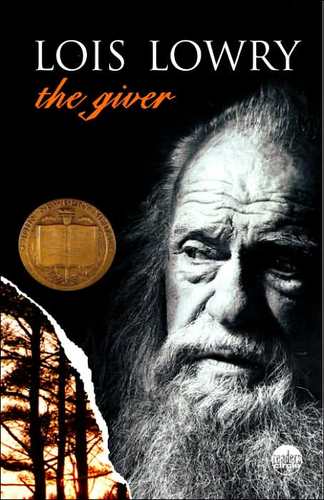
I think that Stirrings are the beginning of puberty. Jonas felt the need to be with Fiona, which, from what I heard, seems to be the signs of the beginning of adolescence. Along with adolescence comes a connection with different people, which could lead to marriage and children.
Now that I think about it, it seems to also be connected to the Octo-mom. America has given her the free will to have children. This has stirred up many different things. She is getting a considerable amount of attention, and people have questioned how much the government should be involved in these kinds of issues.
Then you can look at the China one-child policy. Everything is controlled, and people are unhappy. The government still appears content that everything is in order.
Now look at “Jonas’s community”. Unlike in the US, everything is controlled. They can only have two children (one boy and one girl). Unlike China, everyone is content. I think this is because they don’t know a life with a free will. Everything in their existence has been robotic. The Committee of Elders controls everything so all is in order. They give people pills in order to prevent any problems in the community, where people fall in love. They match people a partner who they will be capable of living a normal, average life with. There is no real love shown between them or the children. Everything is set up in their town to The Committee’s idea of perfect. There won’t be divorce or any controversy whatsoever.
Another one of the questions was whether or not they had privacy of their dreams and thoughts. It depends on how you look at it. I don’t think that anyone can read their minds or anything, but they have to share their dreams and feelings. Then again, they could easily lie…I am undecided.
Release
I know for a fact that releasing is killing.
I read the book in second grade, so my memory is literally as clear as mud. What I do remember is that the way they killed the new children were by sticking some kind of needle in their heads…ugh!
People are wondering why there is releasing. I am still a bit hazy on the subject, but I think that it is because The Committee of Elders wants to keep order in the town. If people knew that they would eventually die, they wouldn’t be as happy about Release at all. To them it seems as if Release is a time of joy and happiness. If they knew, I think there could be a little bit of chaos in the town. People might start questioning whether or not they could trust the Committee. They could attempt to escape.
Another thing I was wondering is what happens to the people that already know what releasing is, like The Committee of Elders, The Nurturers, and actual Releasers. Are they Released, and if yes, are they joyous too?
The question that I asked during class was whether or not anyone dies outside of the Releasing room. By that, I mean could they have a heart attack, disease, old age, etc.
After having time to ponder on this subject, I have decided that everything is so controlled, that it might be impossible for that to happen. Think about it. Everything is so controlled that there couldn’t possibly be diseases. They don’t allow other people to come to their community, so no illness could be carried over. Also, they don’t even know what death is, so there couldn’t be suicide.
Then again, someone could accidentally fall or trip, or even choke…once again, I am really puzzled.
Hopefully when I reread The Giver, these questions will be answered!
thank you
Wednesday, April 29, 2009
Octo-mom or China Policy???

Octo-mom----------------------x---------------------One child policy
As you may have guessed, based on my previous post, I don't agree with either of them. It was required to put it somewhere, so I placed it right in the middle. I don't think they have created an effective solution because there should definitely be a balance.
In my previous post I talked about how I felt about the Octo-mom. She doesn’t have the financial ability to care for all her children properly.
In the post before that, I wrote that I felt as if the One Child Policy in China was unjust, because it is against human rights, and everyone should have a free will.
In my previous post I also mentioned that instead of restricting the amount of children, or allowing people to have fourteen, the government should educate people on the realistic problems they might face if they have children. It would be good if it was a mandatory course for young adults or even teens. They should learn about the pros and cons before making a decision that could throw their own and their children’s lives in the gutter.
One of the reasons that I feel the Octo-mom’s situation was out of hand was because she got a bit out of control with artificial reproduction. The doctor should have learnt about her past and ensured that she went through counseling and determining if having more children was fair. They needed to know whether or not she was considering the fate of her other six children.
I noticed that the one child policy in China is mainly used in the cities of China instead of the villages. That is why the population is still so big. Instead of restricting the rural areas from the birth education, they should also include them and educate them too.
Restricting the amount of child birth or allowing people to go, well, overboard are both not the answer. We need to educate people of all nationalities about the after effects of child birth.
Friday, April 24, 2009
Children for the Wealthy?
I gave it this name because today in class we read an article about an American woman who recently gave birth to eight children.
Normally, I wouldn’t have a problem with a person having eight children, because they wouldn’t have control, but the controversial thing is that she had already given birth to six other children prior to the eight.
So, the situation is basically 14 infants living in their divorced, unemployed, mother’s 3 bedroom house.
I think you understand the dilemma.
Now, as I touched on above, this woman obviously doesn’t have the financial ability to care for all of her children. It already cost her hundreds of thousands of dollars for their birth, and now she is expected to pay so much just to support them?
Facts:
She already had 6 children, but used vitro fertilization in order to conceive more.
For their first year of life, one child will need roughly $9, 171. For 8 children it will cost her $73,368.
To support all of her children from birth till high school, it will cost her $1,375,408.
For diapers for 8 babies it will cost $7,000 per year.
For their college it will cost her $700,000.
This sparked up a discussion in our class, which eventually led to a fishbowl.
(A fishbowl is basically a discussion)
During the fishbowl, we expressed our feelings about what the government should do about this.
In my previous post I talked about the one-child policy in China, and how I felt it is unjust. During the fishbowl, people began talking about how the government should decide whether or not the amount of children a person should be allowed to give birth to should be based on how much money they make financially.
This is absurd!
In China, the same thing seems to be occurring, which is discrimination.
China-
Boys are allowed to be kept, but not girls, during the second birth.
Also, only the richer families could have more children, and pay off the fine!
What we are suggesting for the world-
Richer families should be allowed to have more children.
Notice a pattern?
This brings me back to my headline: ‘Children for the wealthy?’
It is my strong opinion that the amount of money that one makes should have NO effect, whatsoever on the amount of children they are allowed to have.
You may be thinking that the amount of resources in the world may cause us to feel as if we need to control child birth. As I mentioned in my previous blog: THIS SHOULDN’T BE AN ISSUE!!!
If the world worked together or made an attempt at unity, I wouldn’t even need to write any of this. The resources would be taken care of, and there would be no real issues on that subject.
In the article on the ‘woman with the 14 children’, it mentioned that she had been OBSESSED with having children from a young age. She already had 6 and got vitro fertilization in order to conceive more.
It is a FACT that many people in the world would not feel the urge to have this many children.
People have different personalities. Some want 14 children, and some don’t want any.
If the government is worried about people having too many children, maybe instead of making that kind of policy, they could invest more in educating youth on this subject. They could possibly take courses in order to learn about the difficulties of having more children, and they could use that knowledge in their lives in the future!
Since this woman didn’t have children naturally, this is a real issue. Before she had the fertilization, they should put her through rigorous counseling and made her think through this decision. The health care professionals needed to ensure that she was capable of providing her first six children care physically, emotionally, and financially before considering the fertilization again.
Thursday, April 23, 2009
China's one-child policy...Just or not?!
After having more time to think about it, I have decided that I truly don’t feel that it is a just law…for many reasons.
My first reason is that it goes against human rights. Don’t we all have a free will? Not deciding how many children you have isn’t free will. You are being restrained, and have no say in how you decide to live your life. That is definitely unjust.
People may say that a huge portion of the justification is because China will run out of resources. After thinking about this, I have decided that this doesn’t have to be a factor. If the world was one, and there was unity, everyone would help countries like China that would be in need.
Also, who says that whoever was born in China must live there for the rest of their lives. The world in an enormous place. Why can’t people spread their wings and live in another country, or even another continent? If this were to happen, then they wouldn’t need so many resources.
Another reason I feel the law is unjust is because it doesn’t support equality among men and women. I feel as though now we live in an era where men and women should be presented as equals. Apparently this doesn’t apply in Chinese politics!
If a family has a girl, and then another girl, they must give the second girl up.
If a family has a girl, and then a BOY, they may KEEP the BOY!!!
That is UNJUST!!!!!!!!!!!!!!!!!!!!!!
Men are NOT superior to women.
This has caused an imbalance between the amount of men and women in China. There are 117 men to every 100 women. Officials even estimate by 2020 there will be 30 million men known as ‘bare branches’, which won’t have or find a wife to marry.
I hope that if this does happen, it will straighten their views.
I also know the effects it has on the children, because while I lived in America, my friend, Isabel, was adopted from China. Her mother had too many children, and had to give her up. Although Isabel ended up with an extremely loving and caring family, who’s to say that all children will end up like her. They could become foster children, or end up with a bad family. Isabel still always wondered what her birth-mother was like.
It is just as difficult, if not more, on the children; their countries unjust law.
Also, who’s to say that if the law is abandoned that people will immediately begin having children. I think that the reason the baby boom was so drastic was because the people were encouraged to have children. Now that they know the problem, they may only have one or two. They aren’t crazy!
If this law were abandoned, so many problems would cease. There would be no more problems with children being abandoned (girls mainly) and put for adoption.
Even if China did run out of natural resources, at least it will make the world realize that we all need to work together in order to make the world a better place. There isn’t one country on earth that is indestructible.
Thursday, April 9, 2009
Part 2: Shakespeare Sonnet 7
Hi everyone,
Now I am reinterpreting my Shakespeare Sonnet 7 response below. After watching the musical and acting versions of this sonnet my ideas have changed. (Not drawing…I was in that group)
After seeing the two versions, I am beginning to connect the sun's life more with human life.
Play: During the play, the person starting out as a baby (Mark) grew up with the sun (JiWoo) and died with the sun. This makes me think as if Shakespeare was not only writing about the cycle of the sun, but also about how human life is similar.
Musical: During the music, everyone started moving and playing their instruments loudly at noon, which to me was interpreted, once again, to human life. It was as if at that time in the day, which represents middle-aged, was the pinnacle, and most active time.
What these things made me think about:
When the sun starts the day by slowly rising into the sky, it is similar to human birth in some ways. It is like someone that is just born and is opening its eyes to a new world and discovering new things.
As the sun progresses higher and higher into the sky, it reminds me of going through, your toddler years, adolescence, and youth, until you finally reach middle-age.
"And having climb'd the steep-up heavenly hill, Resembling strong youth in his middle age.”
During the time of Shakespeare, the life expectancy of most people was roughly 40 years old. This means that people were considered middle-aged in their twenties. That would mean they were at their peak physically and mentally.
I think he means that the sun is in the middle of its journey through the sky, but is also at its highest point. It is showing that it is still strong, even though it is halfway through its "life”. This can also be said of the human condition during Shakespeare’s era.
As the sun makes its way back down through the sky, when he says “Like feeble age, he reeleth from the day, The eyes, 'fore duteous, now converted are From his low tract and look another way”, could possibly have a double meaning.
It could be talking about the sun, and how people’s attitudes altered towards the suns presence as it sets, and they become unimpressed.
It could also be talking about people: People’s lives change after they have passed “middle-age”. For some people it turns downhill, and they receive problems that naturally occur along with older age, that cause them to be less active, and sometimes, less significant. This is like the sun descending in the sky. It is moving lower and lower and lower…and lower.
For some people it also means that they have missed out on the opportunity of having children. “Unlook'd on diest, unless thou get a son.” Here I think Shakespeare means that if you don’t have a son, your life would have been meaningless. In the time of Shakespeare (which I believe was the 15-1600’s), you would be looked upon insignificantly once you died, unless you had a son who could carry on your name, or do something great.
I guess that this sonnet is both about the sun and people. It depends on who, and how you are interpreting it.
Thanks!