Sunday, April 7, 2013

My reflection on "Failing to Learn Japanese in Only Five minutes"

Whenever I was a kid back in Texas, I’d always tease my parents about how old they were. I’d watched old John Hughes movies and scoff at the record players or Walkmans. I’d laugh over old pictures of them with their big ‘80s style perms and nerdy glasses, dressed in weird bright floral clothes that they vehemently assured me were “all the rage” when taken. 

One time, when I was roughly eight years young, I snuck deep into my mother’s closet and became overwhelmed with giggles at the sight her old drivers license (Debra Winger hair, red lips, and all). Though she graciously laughed along and showed me an old scrapbook, she claimed that one day, in the not so distant future, my children/nieces/nephews would be doing the exact same thing with me. She dared to suggest that I would be the ancient one sharing my photographs, not mocking the age of others. I refused to even acknowledge such a suggestion as being in the realm of possibility. Never would I be “out of date” or “old”. I always held a firm belief that my existence coincided with the absolute and complete development of humankind’s technological capacity. In my mind, the world would stop developing because their was nothing left to develop. I couldn’t have been more wrong. Unbeknownst to me, my mother’s claims would ring true very soon, with the source of such harsh reality to come from none other than my little sister.

Just last week, over the dinner table, my family and I found ourselves reminiscing over our time in America. We remembered going CD shopping fo JoJo records, how we had a cassette player in my dad’s old car, and our VCR, on which my elder sister and I would relentlessly watch Spy Kids and The Sound of Music, constantly having to rewind the tapes after each viewing. We recalled when Youtube just began to grow popular, and how we would still send handwritten cards to our cousins on their birthdays (but had to send them a couple of days in advance so that they would arrive at the perfect time). As we referenced everything nostalgic thing from our past, my little sister was in awe. Half the things we spoke of she didn’t know. She couldn’t imagine a time when our house only had two computers (and we had to unplug the phone to use the internet), a time when the primary use of the letter “i” wasn’t as a prefix for a string of elaborate technological products, or a time when the word “tweet” was only used when reenacting the chirping of a bird during a rousing rendition of "Old MacDonald". Though I am only five years older than my sister, I was the old lady who lived before the technological revolution she was always a part of.

When I realized that, things began to catch up to me. Future generations will look at my drivers license and wonder why I didn’t have a peacock on my head, or why my hair wasn’t bright green. I’ll still be clinging to my letters and DVDs while the young people will have chips implanted in their heads and hovercraft shoes. I can't wait.

Thursday, March 24, 2011

How Ethnocentricity Inducts Conflict


When the British chose to colonize the Australian land inhabited by the Aboriginals, their ethnocentric perspective towards the natives instigated conflict between the two communities. Initially, due to the close relationship formed between Governor Phillip and the Aboriginal Bennelong, the relationship between the two cultures was strong. Unfortunately, due to the murder of many Aboriginals by the whites, conflict arose. Since the British were more advanced when it came to strategy and weaponry, they were able to overpower the Aboriginals, and manipulate them. The Europeans tended to view the Aboriginals as animals, without rights. They were perceived as savages. These beliefs were not simply prompted by the dark skin of the natives, but rather their culture. Aboriginal people believed in the legends of the earth, and in respecting the traditions of their ancestors. With this strong belief, the natives didn’t concern themselves with clothes, and weren’t as driven by ambition as the whites. To the British, man was meant to strive for greatness, instead of being content with the natural world. As seen in the book “The Rabbits”, the ‘whites’ originally came to the native land with a more developed understanding of the world, and were able to take advantage of the inexperience of the indigenous people. “Still more of them came, sometimes we had fights-”. They soon colonized more and more people, and made it clear that they planned to take control. Since the British viewed themselves as superior to the Aboriginals, they chose not to take the Aboriginals' beliefs or feelings into account. They saw the natives as ‘barbarous’ and ‘ferocious’, and viewed them as sub-human, without genuine emotions. This was a great contributor to their drive and longing to wipe out the native ‘breed’. They didn’t want to attempt to understand or appreciate the native lifestyle, because they assumed only their 'way' was right, and all mankind should reach their 'standards'. The British chose ignorance. They rarely made attempts to learn about the Aboriginals. Instead, they gradually eradicated the culture. After failing to remove the Aboriginal nature from Bennelong, they decided that no natives could become ‘civilized’. This developed a negative stigma towards the Aboriginals, resulting in barely any whites attempting to reach out to the culture. The British simply continued to spread around Australia, ruthlessly snatching Aboriginal lands, even replacing the native crops. Many became merciless. Men, women, and children were slaughtered in order to prevent the continuing growth of the Aboriginal population. Whenever natives, such as Windradyne, attempted to fight back, the whites responded by butchering more and more innocent people. Instead of searching for a civil solution, the two cultures continued to tear each other apart. The British refused to respect or value the Aboriginals' rich culture. They not only stole and destroyed the lives of many, but they also spread an addiction to alcohol throughout an entire generation of people. Ultimately, not once ounce of positivity was seized from the experience. Children were stolen, lives were taken, and a culture began to deteriorate. If only the British had initially viewed the Aboriginal culture with a sense of humanity or civility, a massive amount of lives could have been spared. A rich culture might have been greatly preserved. No good can come from an ethnocentric mindset, as is seen throughout the history of Australia.


Thursday, February 24, 2011

Marc Antony's Speech


Context

-->
Before Marc Antony speaks to the people, Brutus gives a speech to the plebeians in order to defend his actions, and introduces Antony as one of the conspirators' allies. After Brutus leaves, Antony begins to present a speech to the people of Rome, in order to get them to rise against the conspirators.

Meaning and Significance
-->
Marc Antony's speech to the crowd is one of the most vital scenes of the entire play, because it is the birth of a new conflict. The audience had been focused on whether the conspirators were going to kill Caesar, and once the assassination was complete, Shakespeare needed to steer the play into a different direction. He heaved the fickle nature of the plebeians to an entirely new level, by making them gradually turn against Brutus, and doubt his renowned ‘honor’. We are also reintroduced to Antony, as he is revealed to be a worthy and formidable threat. Shakespeare employed the powerful words and emotions of Marc Antony to aim the people against the conspirators. Through the effectiveness of Antony's speech, the play with be focused on the aftermath of the conspiracy, and we are left to speculate the fate of our honorable Brutus, and question whether Caesar was genuinely the antagonist of the play.


Act 3 scene 2 (lines 74 - 105)

-->

Friends, Romans, countrymen, lend me your ears;
I come to bury Caesar, not to praise him.
The evil that men do lives after them;
The good is oft interred with their bones;
So let it be with Caesar. The noble Brutus
Hath told you Caesar was ambitious:
If it were so, it was a grievous fault,
And grievously hath Caesar answer'd it.
Here, under leave of Brutus and the rest--
For Brutus is an honorable man;
So are they all, all honorable men--
Come I to speak in Caesar's funeral.
He was my friend, faithful and just to me:
But Brutus says he was ambitious;
And Brutus is an honorable man.
He hath brought many captives home to Rome
Whose ransoms did the general coffers fill:
Did this in Caesar seem ambitious?
When that the poor have cried, Caesar hath wept:
Ambition should be made of sterner stuff:
Yet Brutus says he was ambitious;
And Brutus is an honorable man.
You all did see that on the Lupercal
I thrice presented him a kingly crown,
Which he did thrice refuse: was this ambition?
Yet Brutus says he was ambitious;
And, sure, he is an honorable man.
I speak not to disprove what Brutus spoke,
But here I am to speak what I do know.
You all did love him once, not without cause:
What cause withholds you then, to mourn for him?
O judgment! thou art fled to brutish beasts,
And men have lost their reason. Bear with me;
My heart is in the coffin there with Caesar,
And I must pause till it come back to me.


Tuesday, February 1, 2011

Profile K Evaluation


Today in class Mr. Whiting came in and talked to us about the two hemispheres of our brain: Logic and Gestalt. If someone relies more on the left side of their brain to process information, they are logically centered, and if they rely on the right side of their brain more, they are considered Gestalt. Those who are logical tend to prefer having instruction, work in a neat, sequential matter, and tend to direct their focus towards details. Those which are Gestalt tend to work in a more abstract way, tend to be more curious, and focus on the big picture, without paying so much attention to details.

Through a few forms of testing our brains, I was able to reaffirm that I am a Gestalt person, who is a Profile K Learner (I got the exact same results when doing the same testing in 7th grade).


I learn best when I am given examples of how to do things, as I have trouble following step by step instructions. I prefer not to be told exactly how to apply my thinking, because I feel as though it is restricting me. An example of this would be when writing an essay. I prefer it when I am given an example, and then am able to let my imagination take control of what I am writing. I dislike being given formatting and being told how I am supposed to do things. I use the ‘whole’, and then work with parts of the whole.


Whenever doing work or learning about a new subject, I need to be able to relate to what I am doing in an emotional level, or else I have trouble when attempting to deeply process any sort of information. For Example: When reading Julius Caesar, I was able to understand the protagonist (Brutus), because I understood what it meant to be unsure whether to trust your friends, and how easily even the smartest of people can be manipulated through the use of heavy flattery. Since I was able to relate to the story, I could comprehend the vulnerability of Brutus. Then, I place myself into his mind, and understand the emotions that are provoking his choices.


The strategies that would help me in my learning are to use visuals and constantly change the topic of discussion. Whenever working on a project or learning a new subject, I consistently turn to the use of images, pictures, and diagrams, because they allow me to clearly see the information I am trying to process. I also prefer not having to remain on one subject or topic, because I lose focus. By constantly changing the subject, I come up with new ideas, and am able to exercise my imagination and creativity.


I would like my teachers to know that I prefer being able to debate and have discussions in smaller groups, because it not only allows for my voice to be heard, but I am also able to hear everyone else’s opinions in detail. This not only shares my thoughts to other people, but I am able to see things from a variety of perspectives, and it will expand my thinking.


http://wwwdelivery.superstock.com/WI/223/4128/PreviewComp/SuperStock_4128R-1289.jpg

Monday, October 25, 2010

Art Mirroring Society


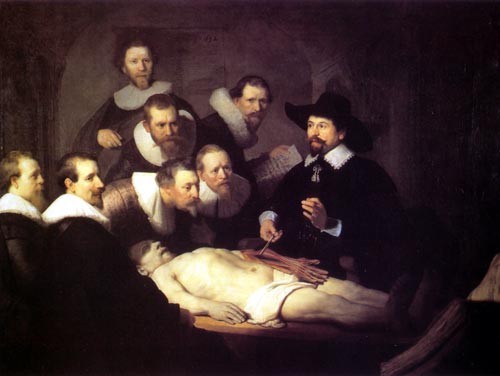
The oil on canvas painting, The Anatomy Lesson of Dr. Nicholas Tulp was drawn by the talented Renaissance artist, Rembrandt, in the year 1632. It illustrates a group of scientist dissecting the body of a burglar who had recently been executed. This painting represents and reflects the culture of the Renaissance, because it shows the progression of scientific knowledge and artistic techniques. Scientific knowledge and discovery is shown through the dissection and study of the dead body. As the people of the Renaissance began to review prior discoveries of the Romans and Greeks, they started to inquire more about the world around them, and questioned the science behind the human body. When the Catholic Church began to loosen the restraints and restrictions of science, scientists were occasionally permitted to expand their research in field of medicine. This led to a better understanding of human anatomy, and instigated more research and development. Rembrandt’s painting not only displays scientific innovation, but it also shows the new methods and techniques of art that were being applied during the Renaissance. The focal point of the painting is the dead body, there is shading and detail on all the men’s’ clothing, and the corpse is anatomically accurate. These new techniques of art enhance the sense of realism and depth in the painting. In the Renaissance, people began to focus on making art look as life-like as possible, and the new styles and techniques led to more interest in patronizing and commissioning artwork. Talented and skilled artist brought attention to specific city-states and initiated rivalry and competition between the different societies. Art eventually became the center of civilization. Through this painting, you can begin to understand the influence the Renaissance’s thriving society had on Europe, and how it was reflected not only through improved artistic methods, but also through the subjects of the paintings.

Tuesday, September 28, 2010

Driving forces of the Renaissance

I believe that the system of guilds was the most crucial driving force of the Renaissance, because it established the civilizations' economy through the development of art and trade, thus stimulating the progression of knowledge and skill during the Renaissance. As the guilds flourished during the 15th century, newfound wealth of the city-states led to grand competitions for the most knowledge, and the rediscovery of lost wisdom. Because of its vital and influencial role in the revival of society, guilds were the foundation of the Renaissance.

image source: http://www.lessons-from-history.com/

Sunday, January 24, 2010

“If you wait, people will forget your camera, and the soul will drift up into view.”

Legendary photographer, Steve McCurry, was born in Philadelphia in 1950. He first pursued documentary filming, but decided to take the road of a newspaper photographer. McCurry travelled the world as a free lance photojournalist, and photographed civil struggles in Pakistan. When he eventually re-entered Pakistan (years later), he had rolls of film sewn within his clothes. McCurry is known for being unrestrained with his photography, and going the extra mile to portray the strife of millions of people through his photos. McCurry gravitates towards people suffering and in pain, and shows the essence of their thoughts. He wants people to stare into the eyes and face of the people, to feel their agony. Through looking at one of his simple, yet magnificent photos, he takes you on an everlasting journey through a stranger’s eyes. McCurry’s vision cannot be withheld inside him. “Most of my photos are grounded in people, I look for the unguarded moment, the essential soul peeking out, experience etched on a person’s face.”

After exploring the many galleries of Steve McCurry, the photo that is always carved into my mind is of a boy running through a hall that is covered with red hand prints. The walls are bright blue, and the prints are a deep, burgundy red. The two colors collide, capturing peoples’ attention. Undoubtedly, the most intriguing aspect of this photo is the aura of mystery. It captures a fleeting moment in the boy’s life and freezes it. The scene is completely up for interpretation. The reader could create many reasons for why the boy was running. Could he be playing a game of tag, did his mother just call him to come over for lunch, or could a man with a gun be just behind the photographer? They could also wonder about the handprints. Were they little decorations for the street, or were they representing the blood of children that were shed in some kind of war? This sense of liberty McCurry set up for the viewer forms a connection, as if they were a part of the scene occurring within the frame. “A good picture makes us curious and makes us want to know more.”

When people first see the photo I think that they mainly focus on the boy running and the red hands. This is because the hands are in the front, and the boy is in the center of the photo, emphasizing the two main features. After staring at the captured moment for a few more seconds, the viewer looks deeper. After my eyes wandered around the page they kept flickering back to the orange wall on the right of the picture. This was put in keenly by McCurry because it subtly shows people the conditions that the boy lives in. The wall is cracking and slowly rotting away. The walls and floor are the background of the photo, and tell their own story of the poverty in the area. The foreground, the boy and hands, shows the intricate attributes and the background, the rotting walls, shows simplicity.

McCurry uses foreground and background, color contrast, size and position, and more in order to have world class photography. He pours peoples’ hearts out through the lens and allows their voices to be heard. Many of his photos show fear through the innocent eyes of children, or the strain on an old woman’s face and McCurry allows their sorrow to seep into peoples’ souls. He shows raw and tender moments in the lives of strangers. “Fishermen cleaning nets, families sharing meals and celebrations, artisans crafting their wares, nomads continually on the move; even the most seemingly mundane activities can be inspirational when you look beneath the surface." McCurry photos display the internal and physical pain of an average person placed in a tormenting, impossible situation. He challenges us to act. It is because of this that McCurry’s photos will endure forever. No matter how much time may pass, the distress on the peoples’ faces will never fade away, and it will stick with you long after you have shifted your eyes away from the photo. It is because of this that McCurry will forever and always be a legend.